GENERATIVE ART / SHAPED BY COLLECTORS
The next shape
is yours to decide.
Discover a living Signal. Reveal its child Fragment.
Edit its pixels and Drift it into something new.
Start here for free. No wallet needed to explore.
YOUR COLORS CAN BECOME A COLLECTIVE SIGNATURE
What if your faction
colored the archive?
You choose the primary mint palette. If a faction keeps minting in its colors, those colors could come to dominate the archive. See the live distribution ↓
Watch the page and generator studies follow your choice. Mixed Signals can include secondary colors. Minting requires a wallet and payment.

ARCHIVE TELEMETRY / LIVE ON-CHAIN READS
Who’s coloring
the archive?
See which primary palettes appear most often. Pick a palette to explore the works carrying it.
Connects to the archive when this section comes into view. No wallet needed.
CHOOSE YOUR SIDE / LEAVE YOUR COLOR
Make these colors part of what comes next. Mint in this primary palette and add to its presence in the archive.
Preview your choice first. A confirmed mint adds a record; selecting a palette does not. Wallet and payment required.One token, one primary palette. Percentages use successfully classified tokens. Fragment counts include burned ancestors; secondary and inherited Fuel colors are excluded. Palette prevalence does not identify a faction or its owners.
How this snapshot is counted
Reads totalSupply and token IDs 1 through that total at one Ethereum block, using parentTraits for Signals and symbolData for Fragments. Missing or unreadable records are reported as partial. Palette names and swatches use the site’s palette catalog, with stored Signal names where available. Auto-refreshes every five minutes while this section is visible; you can refresh manually.
Choose a palette to explore its tokens.
A SMALL CHANGE. ANOTHER POSSIBILITY.
One pixel.
A different fingerprint.
Even this tiny 8 × 8 canvas has 18,446,744,073,709,551,616 possible on/off arrangements.
Pick a square. Turn it on or off. Its pixels change—and its fingerprint changes with them. Undo, and the original fingerprint returns.
Add color and Fuel in the practice editor ↗What the numbers mean
64 independently on/off pixels give 2⁶⁴ arrangements. This is a theoretical canvas count, not mint supply or the number of reachable collectibles.
The fingerprint here is a local SHA-256 demonstration. The mint’s Fragment precheck uses a separate Keccak-256 fingerprint of grid, archetype, palette IDs and packed pixel data. This demo does not check on-chain availability.
Calculating…A generated binary study. Make your first mark.
Reduced from the actual 64 × 64 archetype generators. Colors follow your palette; each cell is still on or off. Free to play. Nothing minted.
Ten forms
a child Fragment can take.
A Signal is the parent artwork. Its child Fragment is a separate pixel artwork. Each Fragment archetype begins with a different set of rules. Follow a silhouette, a rhythm, a break in symmetry. Then look at what changes.

003 / SYMBOLIC
Glyph DNA
A script that almost remembers how to be read.
Look for
How it forms
Explore in the studio ↗These fresh studies use the project’s existing shape generators and actual palette colors. Generating a variation is free; it does not mint a token or change an owned artwork. Explore actual holdings in the collection ↗.
You recognize something.
You cannot quite read it.
The smallest marks begin with familiar letters and numbers. Mirror them. Join them. Interrupt them. Familiarity survives, even when the letter does not.


Illustrated construction using A and R. The generator chooses its characters and disturbances procedurally; the marks do not have an assigned translation.
Then the glyphs become a structure. Glyph DNA layers three to seven marks. Some layers add pixels; others toggle overlapping pixels off. Partial reflection introduces a symmetry that never quite settles.
Then your hand
enters the language.
A Fragment carries the connection to its parent Signal. Keep it as it is, or Drift it: paint, erase, borrow colors, and create a new descendant from your edits.
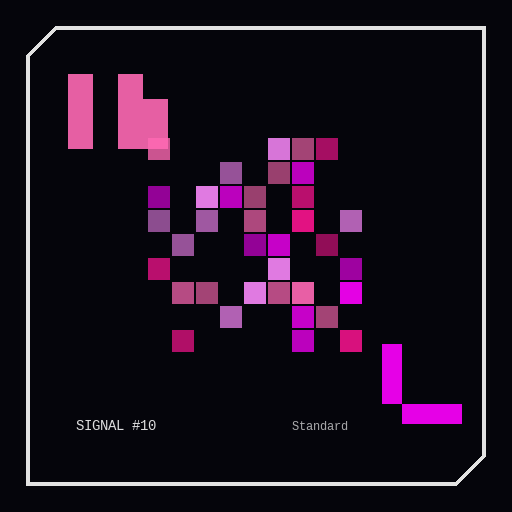
LINEAGE
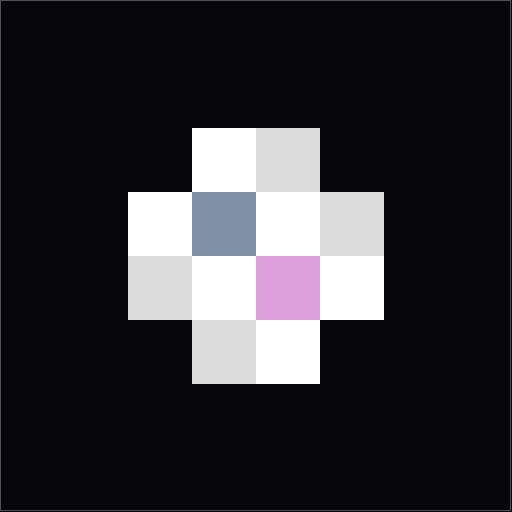
+ FUEL #65
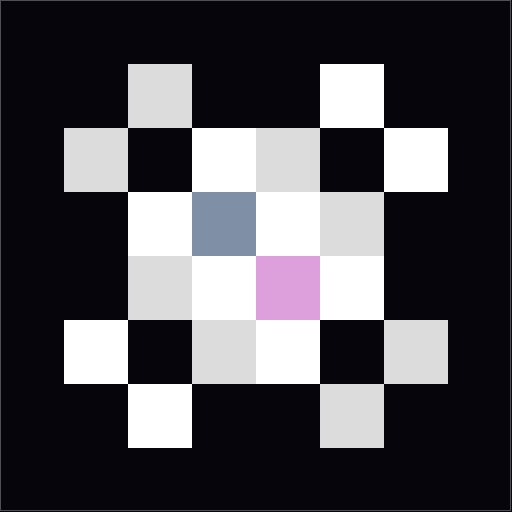
A RECORDED RELATIONSHIPSignal #10 is the recorded parent of these Fragments. #51 is already a fourth-generation descendant; drifting it with Fuel #65 produced #67. These are real minted artworks, shown from their on-chain metadata. Follow the lineage ↗
Drift is the action. Your Source is the Fragment you change in the editor. At least one other Fragment becomes Fuel, contributing edit power and inherited colors. The result is a new Fragment, not an overwrite of its parent Signal.
When you choose Burn + Drift, the Source and Fuel are consumed and a new descendant is minted. Their ancestry remains recorded.
Try the pixel editor · no wallet ↗Find the form
you keep returning to.
Collect a Signal, the living parent artwork. Extract its child Fragment. Drift that Fragment when you want to shape what comes next.
Browsing needs no wallet. Minting and creating a Drift are Ethereum transactions. Read the collecting guide.